CABLE is a regular digest and recap of New Design Congress' efforts to confront the gap between what is said to be happening, and what is actually happening in digitised societies.
CABLE 2024/05 covers two months of activities and is split into two parts. Part one covers announcements and updates about our work and its real world impacts. Part two is a digest of two short pieces from our research and a curated collection of articles from our reading list.
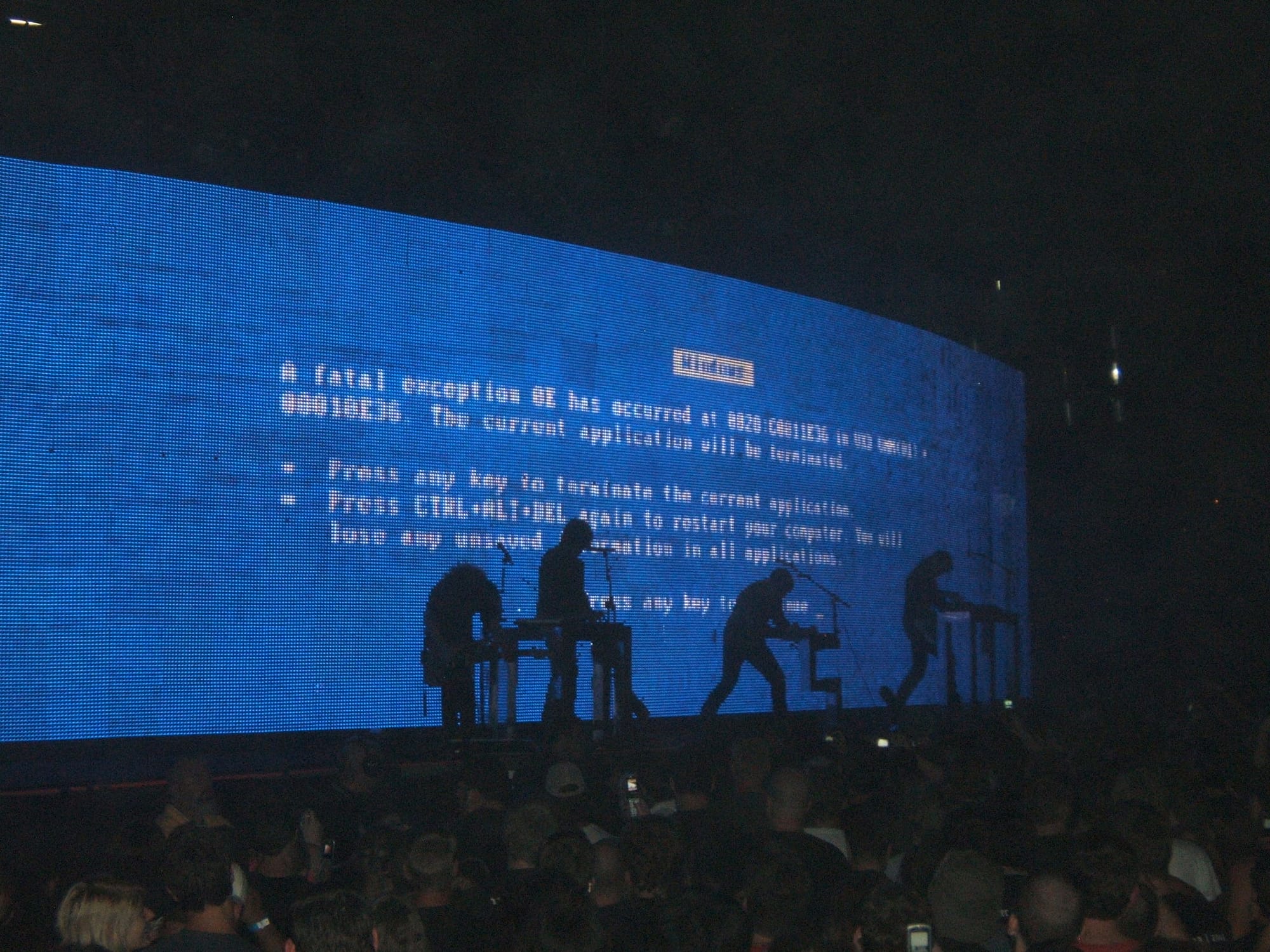
(Header image: The Blue Screen of Death at a Nine Inch Nails concert, 20 August 2008. Photo credit: LtRandazzo)
I. IMPACT + UPDATES
[RESEARCH NOTE]
SPHERES OF IDENTITY

Published in collaboration with Roel Roscam Abbing, our next digital identity Research Note explores the shortcomings of conceptual models for digital identity systems. These models try to provide the means for evaluating digital identities, but in practice, their rigidity is at odds with the amorphous and complex nature inherent in representing people in systems. Spheres of Identity is our final digital identity problem statement, setting the stage for our forthcoming analysis of historic, current and emerging digital identity systems.
[EVENT]
THERE IS PAIN AT THE WORLD BUT NOT AT THIS CON: FURRY SOLIDARITY & THE PARA-REAL
"Spend enough time online and you’ll come across a meme that ‘Furries run the internet.’ Some of us build networks, write code or work as sysadmins, but alongside those who build or maintain our spaces are those who shape the world we want to live in – creatives, organisers, educators and other non-technical furs. And yet, although we are stronger together, we rarely look back out into the wider world to compare. At a time of intense real-world uncertainty, what could the wider world learn from the furry community for safety, community and economic resilience? Join a live conversation with Ån (Systems Design Lead at VRChat) and Shibco, (co-founder of New Design Congress). We will discuss how the social and technical savvy of the furry community offers hope for a more just wider world, and how the tools of furry expression – VRChat, Blender, Unity, OBS, Godot and others – serve as a hybrid “third space” between the digital and the physical, in stark opposition to the doomscrolling mainstream."
In June, Cade and Ån (Systems Design Lead at VRChat) co-presented a presentation at Furality Umbra, an enormous online weekend-length Furry festival hosted entirely in VR. The talk was watched by over a thousand attendees in VR, and more via the Furality Twitch stream.
This talk is essential for anyone seeking an introductory glance into a subculture that actively builds safety and economic power within its own community.
Watch the archived event.
[EVENTS]
A SERIES OF TALKS ON DIGITAL STAGNATION, EUROPEAN POLICY AND OPEN SOURCE
NDC continues to present our research into material futures for digitised societies. In July, Cade presented a keynote at iMAL Brussels Betacamp SuperTele, making a case for the Para-Real as a framework for understanding the atrophy in Europe's art scenes. Two weeks later — and through the same lens — Cade spoke with FLOSS developers in Berlin, proposing an intentional strategy of build relationships to highly literate and technically sophisticated game hackers and modders as allies to open source.
On stagnation, hubris and the solidarity of the Para-Real - NDC Keynote @ iMAL BetaCamp: SuperTele, Brussels, 2024
The European and Open Source dreams of an alternative choice to tech hegemony has failed, and is left behind by a savvy, precarious network of subcultures that harness the para-real to build real networks of social and economic solidarity.
What Comes Next Is Nothing - NDC @ Berlin Mini GUADEC, 2024 Despite their widespread use, OS makers have made irreversible missteps that break trust. Now, a new generation of users have woken up to the political nature of platforms and their alternatives. This presents a unique opportunity to bring new users to FOSS. Who are these users? What are their motivations, and how might they different from assumptions made by free software?
[INVITE]
PARTICIPATE IN OUR DIGITAL IDENTITY RESEARCH
Our digital identity research continues. This is an open invitation to participate in our work. We are looking to speak with security researchers, policy makers, activists, technologists, journalists, academics, artists, and other professionals whose work involves the design, development, deployment or assessment of digital identity systems.
Interviews are approximately 1 hour and 15 minutes in length, and are completely anonymised. Participants can withdraw their consent and exit this research at any time, right up to the date of publication of our findings. Participants will be given a stipend for their time.
II. DIGEST
EUROPE, ENDING
by Cade Diehm
In late July, a leaked draft of the European Commission’s Horizon Europe policy stunned the EU’s open-source community. This policy, crucial for EU digital infrastructure and R&D, revealed a €27 million cut to open source funding for 2025 — a huge reduction to an already underfunded component of the EC’s so-called ‘European digital sovereignty’ strategy. The resulting hole endangers hundreds of projects that are vital to the EU and beyond.

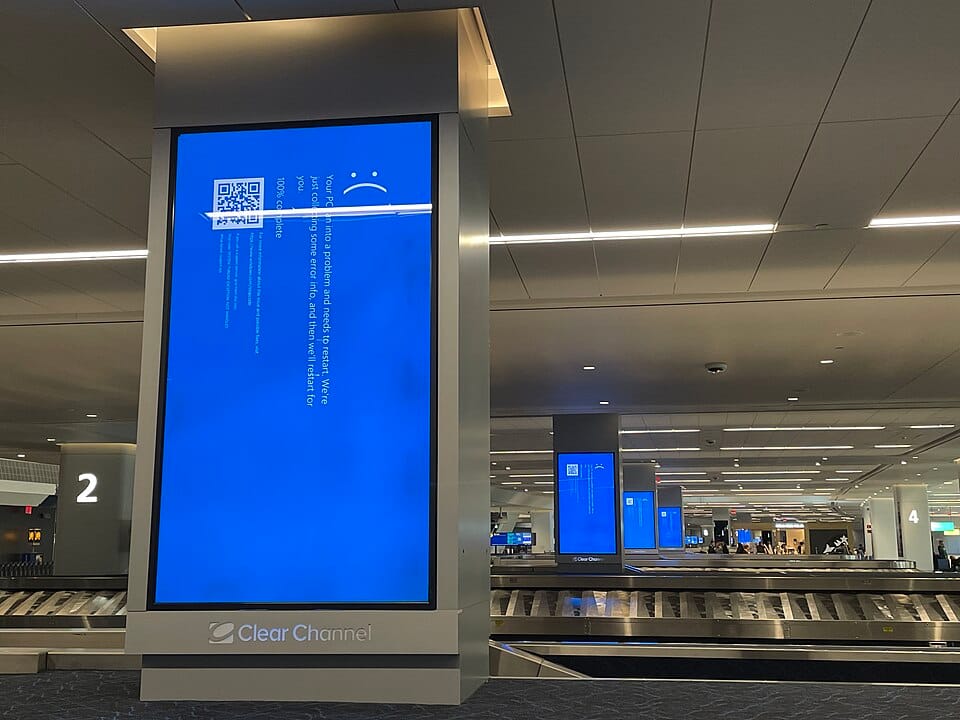
Just days later, the EU and the rest of the world faced an unprecedented global digital infrastructure outage. A flawed software update from digital security company Crowdstrike sent millions of Windows PCs into an endless boot loop, requiring manual, labour-intensive recovery of every affected machine. The core design decisions that make Windows vulnerable to such situations, combined with the wider Microsoft monoculture in government, healthcare, transportation, primary infrastructure and corporate networks provide the perfect conditions for instantaneous and paralysing disruption. Realising this possibility doesn’t even require a malicious actor, the world’s biggest network outage was caused by a failed QA and deployment practice within a third party security vendor.
That the omission of such a small amount of funding to a central component to the EU's digital sovereignty comes to light at the same time as EU infrastructure is paralysed by a reliance on a US-based monoculture is wild. But it is particularly egregious considering the EC’s April 2024 commitment of €112 million to, in part, a ‘European artificial intelligence.’ This investment itself is just under five times the amount cut from the Horizon’s open source strategy, and this is maddening enough. What’s worse is that the EC’s new fixation comes at the exact moment when the AI bubble is well and truly primed to burst.
As AI companies pour billions into increasingly marginal improvements, their services are becoming unsustainable. Their energy and water consumption far exceeds that of cryptocurrencies, forcing companies like Google and Microsoft to ditch their climate commitments. The operating costs surpass even the loss-leading tactics of Uber and Airbnb, which depended on endless VC funds to outlast competitors. And despite the largest tech investment in history, AI remains incredibly vulnerable to manipulation and hallucination, and has carved whole new traumas into societies.

The European Union dreams of a European Internet, but is yet to truly invest in a strategy that has any chance to materialise this dream. Its hard not to look at Europe’s track record in the last seven years — blockchains, metaverse and now artificial intelligence — and not see a reactive body politik whose base priorities and foundations seem to be set by a sector riddled with hype and speculation. The lost momentum and resources to these fascinations contributes to a stagnation of imagination and a narrowing of possibility for Europe’s digital future. Instead, the likeliest outcome is more of the same: a relentless march towards a fragile digitised society rooted in decaying geopolitics.
AI WOULD PREFER NOT TO

The emperor hasn't got much clothes after all. Despite the marketing hype drummed up over nearly a decade, most AI use-cases haven't offered anything substantial beyond the rough automation of basic time-consuming tasks, scam, and trite entertainment. Providing suggestions in a text editor like a glorified Clippy, or generating funny pictures of Trump’s arrest, are far from the Lalaland conjured up by the AI hype. And that’s discounting the abusive ecosystem generated by these tools, which more often than not operate following the slave labour hidden in the walls model—when they work at all. Truly, the AI bubble is bursting.
There is, however, something about missing the forest from the tree in such a statement. The fact that a piece of technology is a complete failure never discouraged its rabid use—on the contrary. AI is bound to continue its downward spiral, and at the same time, be used in the most obfuscated and egregious contexts imaginable, such as the military, intelligence and policing. We're bearing witness to the building of an even jankier version of Operation Igloo White at a worldwide scale.
SNITCHES GET BREACHES

To live in this era is to live to the tune of data breaches. Not a month passes without a major actor of the information economy, private or public, compromised by some kind of attack. Last month, it was the NHS that saw medical data leaked through one of its vendors, suspected to have been targeted as part of the Russian war effort.
This fundamental aspect of our brittle society should be a wake-up call. Efforts should be directed towards limiting the knowledge kept on, and harvested from, individuals and groups. More importantly, the layers of presentation (profile), access (password/passkey) and possession (attributes) should be completely disentangled, much akin to the separation of the executive, legislative and judicial powers.
This is unfortunately a course of action that the digital identity field at large is uninterested in pursuing, and on the contrary doubling down on going against. And while the digitisation of identifiers, governmental processes and accountability can obviously produce positive outcomes, first and foremost when tailored to very specific situations, the digital identity movement is something else entirely. It is the deployment, at massive scales, of multi-faceted stacks fed by 360º KYC processes that so intertwine presentation, access and possession as to already generate degenerative outcomes where data breaches only increase in intensity and deleterious effects.
OF INTEREST
Curated by Louis Center

GOLDMAN SACHS: Gen AI: Too Much Spend, Too Little Benefit? - This month's digest focuses heavily on the turning opinion on artificial intelligence and increased scepticism of its claimed benefits. This report from Goldman Sachs comes almost a year after the firm published its optimism for LLMs and the future prospects of AGI.
404 MEDIA: Leaked Documents Show Nvidia Scraping ‘A Human Lifetime’ of Videos Per Day to Train AI - From the article: "When asked for comment about Nvidia’s use of YouTube videos as training data for its model, a Google spokesperson told 404 Media that the company’s “previous comments still stand,” and linked to an April 2024 Bloomberg article where YouTube CEO Neal Mohan said if OpenAI used YouTube videos to refine Sora, its AI video generator, that would be a “clear violation” of YouTube’s terms of use."
THE GUARDIAN: Sound clashes are a thrilling reggae tradition. Will AI ruin them? - From the article: "Most selectors only use seconds of a dub “to get the point across,” says Anderson. Songs cannot be repeated, so a host of dubplates are required to ensure momentum. It’s a costly process, which has led to a commonplace practice of splicing – copying dubplates and erasing the original sound system name drops – to get tracks cheap. With the arrival of generative AI, the game is getting dirtier still. “AI is even worse [than splicing],” says Fabian Anderson."
R&A IT STRATEGY & ARCHITECTURE: When ChatGPT summarises, it actually does nothing of the kind - An examination of Summary-as-a-Service, an often cited AI productivity promise. From the article: "ChatGPT doesn’t summarise. When you ask ChatGPT to summarise this text, it instead shortens the text. And there is a fundamental difference between the two. To summarise, you need to understand what the paper is saying. To shorten text, not so much. To truly summarise, you need to be able to detect that from 40 sentences, 35 are leading up to the 36th, 4 follow it with some additional remarks, but it is that 36th that is essential for the summary and that without that 36th, the content is lost."
SOATOK: Furries Are Losing the Battle Against Scale - An analysis by a Furry cryptography researcher on the swelling popularity of Furry subculture and the threats of scale to the community.
AEON: We need new metaphors that put life at the center of biology - A compelling argument against seeing the world as systems. From the essay: "The need for a new narrative isn’t just about communicating science; it also impacts how science is done. In 2013, the cancer biologist Michael Yaffe bemoaned the paucity of clinical advances that have come from a search for cancer-linked genes. We sought those genes, he suggested, not because we knew they were the key to developing new treatments so much as because we had the techniques for looking: ‘Like data junkies, we continue to look to genome sequencing when the really clinically useful information may lie someplace else.’ But then, where? What do we now know about how life works that might lead us to a more fruitful destination?"
DATA & SOCIETY: A Working History of the Verified Internet - An ongoing multi-part research project into trust and what it means to be a human on the internet.
MATT STOLLER: BOOM: Judge Rules Google Is a Monopolist - Matt Stoller is Research Director for the American Economic Liberties Project, and a strong anti-trust advocate. From the post: Fifteen years after it was first investigated, search giant Google is finally going to be held accountable for unfairly thwarting competition. In this piece, I’m going to discuss the complaint against Google, why it lost, the next steps, and what this case means for American business going forward.