And you may ask yourself
“How do I work this?”
And you may ask yourself
“Where is that large automobile?”
And you may tell yourself
“This is not my beautiful house!”
And you may tell yourself
“This is not my beautiful wife!”[1]
If you’re reading this, you probably already know that the world has completely changed in just a few short months. The organisations you worked for, funded, or depended on either no longer exist or are unrecognisable. The people responsible are game show hosts and podcasters and seemingly irrational, terminally-online billionaires, and that fact adds to the disorientation.
What you may not yet have is a framework for why this happened, why the people who seized power are who they are, and why their grip on power is far more brittle than it looks. It might seem tempting to look for answers that neatly explain everything. There are many reasons why, but here are two.
In 2025, two trajectories converged: the apex of technocratic authoritarianism, and the collapse of the civil society apparatus that was supposed to prevent it. This is a long piece and it covers hard ground: how and why the US-led institutional apparatus collapsed the way it did, who are the surplus elites who supplied the final push, and what opportunities exist to build a new kind of post-institution in its place. The question that remains is: what you build with its place?
“The Great Non-Profit Non Grata,” or, What happened when civil society met technofascism
Letting the days go by
Let the water hold me down
Letting the days go by
Water flowing underground
Into the blue again
After the money’s gone
Once in a lifetime
Water flowing underground[2]
From the very beginning, the COVID-19 pandemic accelerated inequalities, coerced essential workers into dangerous conditions, and proliferated surveillance technologies with remarkable efficiency. The contrast between institutional outputs and community action was stark. On the ground, communities organised their own survival through mutual aid networks that emerged with striking speed and scale[3]. In the United Kingdom alone, over 4,000 mutual aid groups formed within days of lockdown, involving an estimated 3-4 million people.[4]
As entire populations fought to support themselves directly, civil society organisations responded to COVID-19 overwhelmingly through analytical work. Chatham House published reports on “Emerging Lessons From COVID-19” and pandemic preparedness. CARE International published multiple policy briefs on COVID-19’s “gendered implications”[5] while being notably more focused on policy analysis[6] and advocacy[7]. The World Economic Forum generated strategic reports on resilience and recovery. Few provided direct material support.
For this kind of civil society apparatus, the desk-based response to COVID-19 was the direct consequence of a multi-decade professionalisation that created organisations better equipped for policy analysis than grappling with material circumstance. A December 2024 Jacobin article by Anthony Nadler[8] describes this transformation directly, arguing that progressive civil society had “come too close to abandoning mass politics”, and had fostered “an unhealthy, codependent relationship with the Democratic Party,” and its international analogues. When the inflection point hit in 2020, civil society organisations were largely prioritising campaigns that “most excite donors and funders” rather than addressing immediate community needs.
Less appreciated – though perhaps more consequential – was how the pandemic revealed the structural brittleness[9] of the funding architectures that[10] civil society relied upon[11]. When global lockdowns were first implemented in April 2020, corporate donors and philanthropists alike paused their capital obligations en masse. Funders adopted a risk-managed, wait-and-see approach that was, in hindsight, a pretty obvious warning sign. By November 2020, as resources finally began flowing again, Trump appointees launched a late-stage assault on civil society infrastructure[12]. Biden’s win brought a swift end to this attack, and the danger was perceived to be over.
The 2020 funding freeze pointed at something far larger than the chaos of the pandemic. Despite the relief of Trump’s loss, the authoritarian movement that would come to cut off civil society’s cash supply permanently continued moving from strength to strength, despite hundreds of millions poured into ‘anti-dis/misinformation operations,’[13] ‘ethical tech,’ and other initiatives designed to stop them.
For nearly fifteen years, victories that civil society had considered impossible just… kept happening. Brexit was a shock[14]. Trump 2016 was a shock[15]. Bolsonaro was a shock[16]. Each time, the same institutions that had failed to predict the previous “impossible” outcome confidently assured everyone that they had learned from their mistakes and could now see clearly. Each time, they were wrong in precisely the same way. The unthinkable – which was becoming very fucking thinkable even before large swathes of the ‘old country’ voted to destroy its own economy and isolate itself from the European Union – should have been at the forefront of everyone’s minds. It just wasn’t.
By 2025, civil society’s polite society had accumulated a perfect record of strategic surprise in the face of entirely visible trends. At the same time, emboldened by the ‘shock win’ of Trump in 2024[17], this coalition of authoritarians had also evolved. Now with a firm grip on the levers of the world’s only superpower, they were far more organised than their first go in the big chair.
The right-wing movement had spent decades deploying a myriad of tactics for success, including conspiratorial rhetoric targeting figures like George Soros and Bill Gates[18], or working hard to advertise and publicise the Epstein connections to the very wealthy donors civil society had spent decades cultivating[19]. The targeting worked[20]. Once in power, the new administration’s acolytes – Epstein-adjacent among them[21] – began their work settling old scores and rolling out ‘The Plan’, systematically victimising the US’ most vulnerable citizens and vandalising the US federal government.
Nowhere was this more intensely concentrated than Elon Musk’s Department of Government Efficiency (DOGE). Named after a cryptocurrency shitcoin co-developed by an Australian in the 2010s[22], DOGE was efficient in one thing only: giving right-wing Zoomers, safely nestled in the bosom of an erratic South African billionaire, the absolute permission to wreak havoc on the Great American Institution. In the short ten months of its official existence, DOGE targeted over 280,000 federal workers and contractors across multiple department[23], together representing 48% of all job cuts announced up to August 2025[24]. DOGE operated with chaotic efficiency and met no meaningful resistance[25], even as commentators expressed what can only be described as performative outrage at the “illegality” of proceedings.
Almost to the second after the cashflow was cut, civil society descended into chaos. For non-profits specifically, the cuts manifested through terminated contracts, frozen grant disbursements, and DOGE’s takeover of grants.gov[26], which processes over $500 billion in annual awards used by thousands of organisations. The cost to humans, animals, and the climate may never be known.
Like the rolling shocks of ‘unthinkable’ election victories, this was something that could have been anticipated. Years earlier, the Ford Foundation’s BUILD programme evaluation surveyed the civil society landscape during COVID-19 and concluded the rather shocking fact that less than 25% of non-profits maintained just six months of cash reserves[27]. This statistic revealed an entire ecosystem of organisations claiming to address systemic problems while operating with less liquidity than the average food truck. And yet, despite a full fifteen years witnessing the right wing claim victory after victory, despite the 2020 COVID freeze on donor funding, despite everything, nobody saw it coming. Nobody had any obvious plan in place to diversify or weather the crisis.
The experience of Open Technology Fund (OTF) during this period offers a particularly illuminating case study. Originally created in 2012 as a pilot programme[28] at Radio Free Asia (RFA) and Voice of America (VOA)[29] OTF found itself caught in a bureaucratic stranglehold when Trump’s appointees came for Internet freedom infrastructure in 2020[30] – entirely predictable for an organisation whose mission was literally understanding how authoritarians operate. After surviving that assault thanks to Trump’s election loss, OTF emerged off the back of a Congressional authorisation for independence[31], declaring “a new era of independence for the critical project”[32] with messaging that conveyed institutional invulnerability[33].
What OTF neglected to mention – to grant recipients and the broader internet freedom community – was that the vast majority of its funding still flowed directly from the same USAGM pipeline that had been used to strangle it in 2020. Just two months into the new Trump 2.0 regime, the administration’s DOGE machine and other actors targeted RFA, VOA, and USAGM, and the money-pipe slammed shut[34]. OTF’s legal counsel urgently filed an injunction against the administration to protect itself from suffocation[35]. In doing so, the organisation’s carefully constructed narrative of independence quietly collapsed within days.
Facing the existential threat of grant termination in March 2025, OTF pivoted its rhetoric away from its prior Clinton-era internet freedom aspirations[36], to a clear and explicit anti-China, anti-Russia operation. This, of course, was not new, but the organisation had never quite gone so far as to say the quiet part out loud.
Board chair Zach Cooper laid this shift bare, arguing in public that “the Chinese government is spending billions of dollars to erect the world’s most sophisticated censorship apparatus,” and positioning the funding cut as tantamount to “drastically weaken[ing] American national security.” The complaint warned that “over 45 million people in China, Cuba, Iran, Russia, Myanmar, and other repressive information environments will lose access to OTF-supported secure anti-censorship tools.”
The “independence” was legal theatre; the financial dependency remained absolute. Although OTF had historically been no friend of the Chinese state, the new framing erased whatever ambiguity remained by recasting internet freedom[37] as an American weapon rather than a human right. In doing so, OTF conscripted every developer, activist, and grant recipient in its ecosystem into a great power struggle they had no say in joining.
One reviewer of this essay described it with uncomfortable precision: “Anti-China framing is what happens when you’re funded by geopolitical instruments, and your survival options are constrained by those instruments.” The rising power (China) now had explicit justification to treat OTF-funded tools as hostile infrastructure. The falling power (America) was busy transforming into its own authoritarianism. Between the two, there was no sanctuary.
In December, OTF’s lawyers won a preliminary injunction against its opponents in the D.C District Court[38]. In a carefully-worded email release consisting of just four sentences, OTF’s president, Laura Cunningham, announced the good news to the civic tech worker community that depends on those funds for their livelihood: “[We are] optimistic about what’s ahead and excited to be able to work together again to defend internet freedom for those who need it most.”[39]
But this was a Pyrrhic victory. OTF sacrificed its strategic positioning, its community[40], and expended countless operational hours over nine months to beg the same institutions it had declared emancipation for protection, all for just over a third of its yearly budget of nearly fifty million dollars.
It’s true that civil society leadership teams were presented with an extraordinary political environment. What the first half of the 2020s demonstrated something worse than incompetence or moral failure: Civil society had become structurally incapable of seeing anything beyond its own comforts, its own reporting metrics, and its own operational assumptions. The same adversary returned, better organised, and far better prepared. What the authoritarian apparatus met was a civil society architecture that had not truly hardened in response, because civil society had lost the capacity to respond to material conditions. Civil society’s collapse displaced precisely the people who had assumed their positions were permanent.
And in that collapse, you can hear clearly the death rattle of Cold War economics, the spectacular end to Fukuyama’s short-lived End of History pinkie-promise[41]. Some institutions fell to earth without even a whimper, their directors discovering one morning that decades of carefully cultivated influence had evaporated overnight.
Others – and I speak to you plainly from painful and intimate experience – turned cannibal. Without shame or decorum, they devoured their allies and their own children in desperate, grotesque attempts to survive another quarter. What they all have in common is a shared façade of legitimacy, resilience, and insight. Each came down with spectacular clarity, each a wingless fuselage, quietly descending to the depths of the ocean floor.
“May You Live In Interesting Times!” or, What happened to the world when the world mass-produced billionaires
Water dissolving, and water removing
There is water at the bottom of the ocean
Under the water, carry the water
Remove the water at the bottom of the ocean
Water dissolving, and water removing[42]
How did the political landscape change in such a short time?
To answer this, we turn to elite overproduction, a politico-economic theory developed by the historian Peter Turchin.[43] Elite overproduction describes a state in which societies that generate too much new-money wealth subsequently struggle with a disruptive emergent class of aspirational elites who compete with the finite resource of institutional power. The nouvelle riche are incentivised by this resource battle to either create alternative institutions and infrastructure to cultivate their own power, or capture existing ones through increasingly destructive means.
Since the late 1970s, worker productivity has risen while wages stagnated. This is a hangover from the Reagan/Thatcher hellscape we are yet to escape from. The resulting trickle-down economics – a rat’s nest of tax structures, deregulation, the quiet strangling of organised labour – funnelled value upward over decades. This is a process that Turchin calls the “wealth pump;“ concentrated wealth producing an ever-growing class of people with the resources, credentials and expectation of elite status.
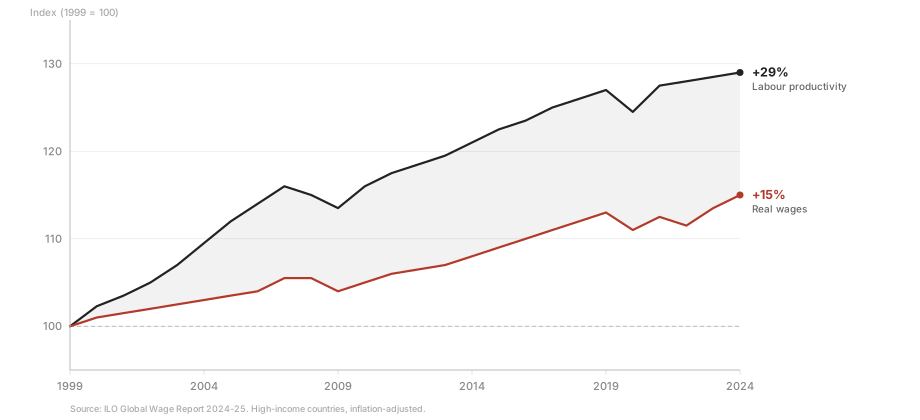
Between 1999 and 2024, labour productivity across high-income countries grew by 29%, while real wages grew by just 15%. The pooling of wealth at the top produced an ever-growing class of people with the resources, credentials and expectation of elite status. But the positions conferring actual power are institutional positions in rigid structures that do not scale with the aspirant class. The result is an emerging aspirational class who have everything except the thing they actually want: the ability to personally press the button and bomb a foreign country. Turchin identifies these people as counter-elites — people wealthy enough to expect actual power, have hit the limits of capital's affordances, and are furious enough the denial that they now wish to burn it all down.
Counter-elites litter history. The industrialists of the late nineteenth century — Henry Ford chief among them — built manufacturing plants to atomise and exploit their workforce before antagonising the status quo entirely (Ford was famously a Nazi[44]). The late Roman Republic — always a favourite for the vapid, leering strongman — is a textbook example: competing aristocratic factions whose members discovered that traditional senatorial careers could no longer accommodate their ambitions, leading Caesar, Pompey and Crassus to seek alternative pathways through military commands and provincial governorships that ultimately led the republican system they ostensibly served into oblivion.
What makes our current moment historically unique is that we’re witnessing a chaotic institutional capture unfold while also watching the traditional elite absorption mechanisms collapse in real time, marked by one of its earliest and most visible casualties – the demolition of the soft-power civil society apparatus.
The ‘unthinkable’ shocks of the past decade are, without a doubt, examples of this dualism: In the European Union, traditional party coalitions have fragmented in the face of their own alliances of impotence[45], as establishment politicians discover their institutional credentials provide insufficient leverage against populist challengers backed by alternative funding mechanisms[46]. The United Kingdom’s post-Brexit realignment displaced entire classes of Eurocratic professionals while creating opportunities for previously marginal actors to lay claim to the Conservative party and the fringe right.
But it’s the United States where elite overproduction theory finds its most vivid contemporary expression: Wielding outsized external influence, Trump’s second administration represents something unrecognisable to the institution: hostile takeover executed by TV celebrities, failsons, and podcasters, who months ago exerted exactly zero real influence over the world.
Consider, again, Elon Musk. Once kept at arm’s length by Obama and Biden inner administration circles[47] despite being the world’s richest person, Musk co-headed DOGE with an unprecedented bureaucratic destruction mandate. Dana White, the UFC president, serves as a close White House ally[48], a fact that was inconceivable even under the first Trump administration, let alone a more ‘traditional’ Republican worldview. Robert F. Kennedy Jr., the famed dynastic misfit whose environmental activism, vaccine scepticism[49], and half-eaten worm-brain[50] rendered him toxic to traditional Democratic networks, finds institutional belonging as Health and Human Services Secretary.
Television personalities, MMA promoters, cryptocurrency entrepreneurs, and podcast hosts occupy positions traditionally reserved for career politicians, military officers, and policy professionals[51]. All of it makes perfect sense when you realise each of these people is a member of the surplus elite class.
Contemporary elite overproduction has a theoretically distinct twist: an intellectually-driven framework that, for the purpose of brevity, is largely represented in this text by two figures who anticipated precisely this institutional displacement and how to exploit it: Curtis Yarvin and Nick Land.
Yarvin, a computer engineer and inventor of the stagnant Urbit project[52], spent years writing under the pen name ‘Mencius Moldbug,’[53] perhaps fearing blowback for his beliefs. Yarvin’s neo-reactionary worldview argues that democratic institutions have already been captured by informal elite networks – a structure he calls “the Cathedral.”[54] Through this capture, democracy is nothing more than a theatrical performance that conceals actual power relations[55]. The logical conclusion: why maintain the theatre when you can govern directly through systems that operate beyond democratic accountability?
This is, at its core, a borderline antisemitic worldview[56], albeit one that replaces “the Jews control everything,” with the slightly less controversial parallel, “the Elites control everything.” But we are splitting hairs here; this is the unmistakable whining of the surplus elite have-not, an individual standing at the gates, excluded from the party inside and plotting to burn it all down in the shadow of such rejection.
Nick Land is one of accelerationism’s earliest architects[57], a former Warwick academic who traded continental philosophy for Shanghai-based crypto-accelerationism[58]. Land argues that capitalism is an “abstract machine” evolving beyond human control or comprehension[59], and that fighting for democratic oversight over it is counterproductive[60].
What matters is how these figures digest Turchin’s elite overproduction theory and simultaneously demonstrate the theory’s own internal workings in real time, with varying degrees of self-awareness: Yarvin offers the theory: democratic institutions are already captured, so why not capture them properly? Land supplies the methodology: technological systems naturally evolve beyond democratic control, so why resist the process? Together, they provide both the permission structure and operational framework to lay waste to existing arrangements, and the mandate to re-shape what’s left in their own image.
Yarvin and Land went from internet posters to being central ideological figures of a movement that successfully architected the near-total deletion of the NGO-industrial complex. They matter, unfortunately, because they articulate the kind of future favoured by Silicon Valley’s far right, which achieved more political influence once they pivoted to taking over the MAGA movement by force than they ever did over decades of attempts to tickle the erogenous zones of the traditional Republican and Democratic Parties. Thiel’s ‘PayPal Mafia’[61] in particular find themselves for now at the top of the power hierarchy.
The same is true for Musk’s devolution from liberal darling (Obama’s favourite arm’s-length entrepreneur)[62] to an infrastructure-owning, 24-hour-tweeting mega-MAGA frontman. An unsophisticated but popular view is that Musk “lost his mind by being online a lot,” but it’s far more likely this transformation into a chainsaw-wielding, kitchen-sink carrying, Twitter buying, Epstein-adjacent[63] MAGA proponent was less of an ideological evolution and more of an opportunistic surplus elite seeing the writing on the wall and going along for the lithium-powered ride. They are all massive Yarvinheads and Landboys[64].
The pattern isn’t ideological conversion, because there is no meaningful ideology here. In its place is likely something more profane and biological: the discordant horror of irrelevant wealth that compels these hoarders to do anything they can for the opportunity to shape the world.

When traditional Democratic and Republican networks treated them as funding sources rather than strategic partners, they simply built different networks. The first Trump administration relied heavily on traditional white nationalist networks – Steve Bannon’s Breitbart ecosystem, Stephen Miller’s immigration apparatus, and the broader infrastructure that, in 2015, was called the ‘alt-right.’[66]
With the surplus elites entering the picture, by 2025, that displacement was nearly complete – a near-perfectly executed capture. This remarkable change can be truly captured by the tears of Steve Bannon, who loathes the fascist technocrati and makes no secret of it: “Peter Thiel, David Sacks, Elon Musk are all white South Africans,”[67] Bannon said in an interview with the Corriere della Sera newspaper in Italy, “Go back to South Africa. Why do we have the most racist people on Earth, white South Africans, making any comments at all on what goes on in the US?”[68] Just take the L and move on, Bannon!
But why technology, and why now? There are many reasons – thresholds of money, structure, and discipline, yes – but also because the new generation of tech is a distinct lineup: large language models, the metaverse, cryptography, cryptocurrency, digital identity, and quantum computing. Together, they form an uninterpretable frontier that simultaneously penetrates everything while remaining incomprehensible to democratic oversight[69].
In our work at New Design Congress anticipating the threats of emerging technologies, we describe this as a boom-extract-enforce[70] trajectory that repeats itself over and over[71]: boom (create new technological domains), extract (capture value through artificial scarcity), enforce (use technological complexity and ubiquity to prop up the state and/or prevent democratic interference). It is as effective as it is totally boring, exploiting the predictability of enforcement via opacity rather than direct violence. By the time the new technology hits the civil-society funder circuit, the infrastructure is already considered ‘too embedded’ to remove.[72]
Consider the spectacle of RadicalxChange hosting an academic debate with Curtis Yarvin in September 2025[73], as though the threat could be contained by the formality of a panel discussion. The Brussels bureaucrat and the whatever-it-takes NGO executive director are born from the same world: mechanisms of institutional power unwilling to evaluate the grinning alter[74] across the table, and in denial that they are in material danger.
What separates them is that the non-profit lead is shell-shocked because the Shock Doctrine hit them first. When combined with the opaque technological frontier that equally resists its democratic audit, the resulting conditions are precisely exploited by the technology-driven surplus elite.
And they’re winning, for now. The most horrific example is one unfolding right now, in public. In NDC’s forthcoming flagship report, The Digital Identity Event Horizon,[75] we draw a straight line from the late David Golumbia[76] to the material horrors of tech-infused infrastructure in 2025, and how the values of cyberlibertarianism are openly self-contradictory, alternating between the view that governments are unable to use laws to regulate digital technology and the view that governments must not be allowed to use laws to govern the para state.[77]
The cyberlibertarian surplus elite project is made most legible in Web3’s one and only meaningful civics project: El Salvador’s transformation into a crypto-carceral pipeline. Bitcoin maximalists Max Keiser and Stacy Herbert fundraised for Nayib Bukele[78] in BTC during his successful 2019 campaign[79], were subsequently appointed by presidential decree to run the country’s “National Bitcoin Office,”[80] and used that position to engineer the capital injections, including Tether’s relocation[81]. Both were investors in Bitfinex/Tether, giving them a financial stake in the very ecosystem they were appointed to regulate[82], tied directly to the incoming US administration[83].
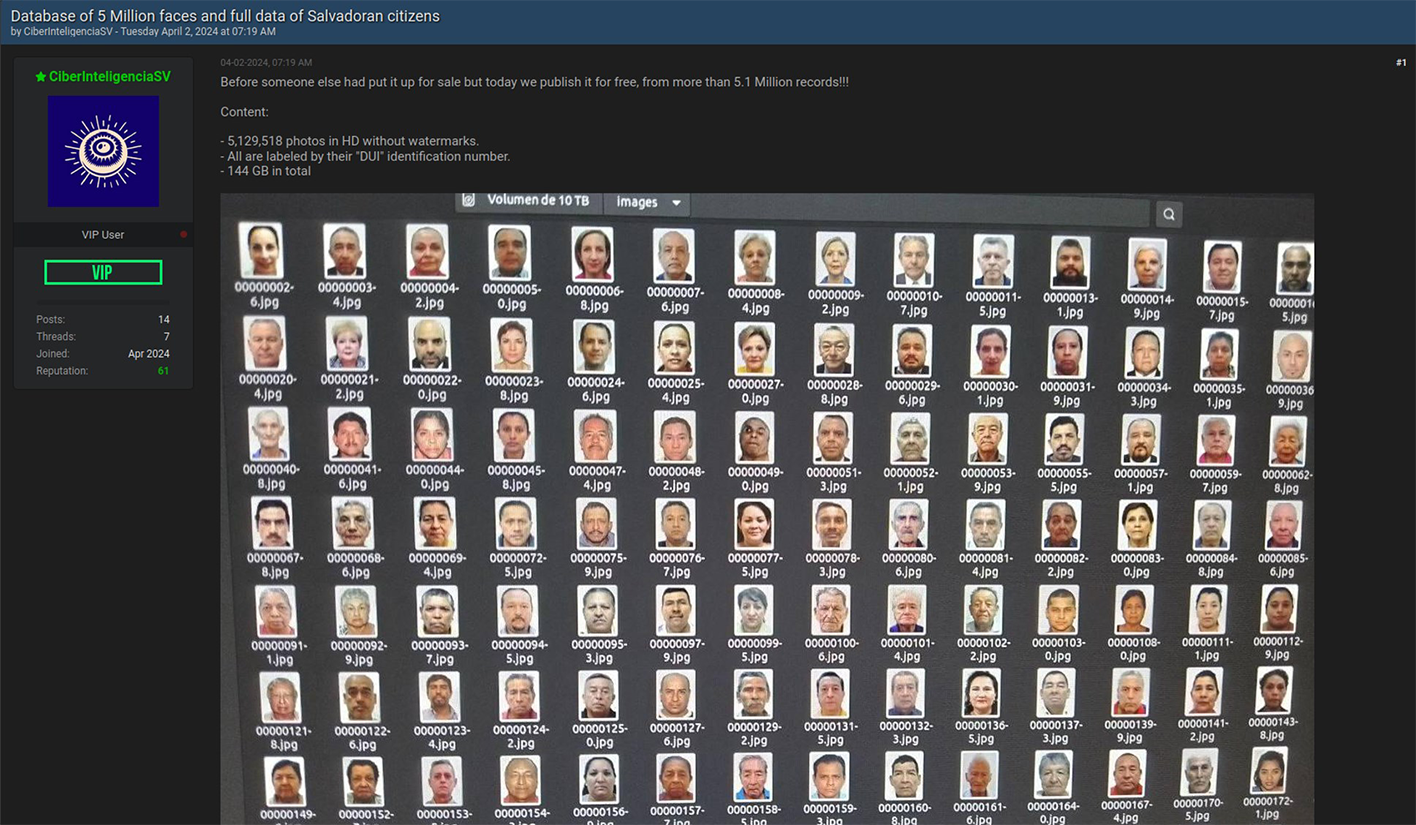
Alongside this, the operation brokered a US$1 billion “Volcano Bond”[84] — potentially diverting half the proceeds into Bukele’s own Bitcoin treasury[85]. Shortly into his presidency, Bukele declared Bitcoin as legal tender[86], with the Bitcoin Law compelling businesses to accept it, and for citizens to enrol in a biometric wallet called Chivo.[87] The Chivo wallet has already leaked 144GB of personal data[88]: high‑definition headshots, names, birth dates, addresses, and identity numbers for more than 5.1 million Salvadorans[89].
At the same time, Bukele broke ground on the 40,000‑capacity CECOT megaprison — officially the “Terrorism Confinement Centre.”[91] Cells designed for over 100 inmates have eighty bunks, minimal ventilation, and two toilets; at capacity, each prisoner occupies 0.6 square metres of space.[92] A 2024 report by Cristosal states that at least 265 detainees have died in Salvadoran custody[93] since the country’s declared state of emergency began, amid conditions without light, hygiene, or access to food[94].
Over the course of half a decade, crypto’s libertarian promise turned into hard policy power: industry PACs and dark-money groups spent more than US$130 million on the 2024 US elections[95] and a further $10 million on Trump’s inaugural fund,[96] securing the first openly pro‑crypto administration.[97] Within weeks, the administration invoked the Alien Enemies Act of 1798 and authorised the removal of any person linked to Venezuela’s Tren de Aragua[98], without notice or hearing.
On 16 March 2025, a charter flight carried 238 Venezuelan asylum-seekers, most with no criminal convictions[99], from Texas to CECOT, where they subsequently disappeared.
The Hong Kong philosopher Yuk Hui challenges the concept of technology’s neutrality via a concept he calls cosmotechnics; “the unification of the cosmic and moral order through technical activities.” El Salvador’s Bitcoin experiment has crystallised a crypto-carceral cosmotechnics:
Bitcoin‑as‑legal‑tender, the biometric Chivo wallet, and the 40,000-inmate CECOT megaprison fuse code and corporeality in a single apparatus of uninterpretable control[100].
To evaluate this infrastructure is therefore to confront what Hui warns are the planetary stakes of allowing a single technological cosmology to eclipse all others: when software is elevated to cosmic law, the most malevolent desires emerge as its material outcome.
Spend enough time in the discourse, and you will undoubtedly hear people describe the current spectacle as a zero-sum end game, or a “new normal.” Indeed, the surplus elites believe it, hence the race to capture AGI – the ultimate lightning in a bottle in the mythical battle for tech-driven dominance.
But the survivors believe it too. If you’ve spent time with the think tank refugees, the displaced foundation programme officers putting out hundreds of CVs every day, or the shell-shocked NGO executives, you’ll recognise the thousand-yard stare of people who’ve witnessed institutional apocalypse, and they’ll tell you, wide-eyed, that the techno-authoritarians have built systems too sophisticated to resist.
They’re wrong. This apparent technological sophistication masks extraordinary brittleness. In Who Will Remember Us When the Servers Go Dark?,[101] I describe the material reality of digital society: A ‘civilisation’ described by Barlow in the Declaration of Independence of Cyberspace as ‘new and unburdened,’ but also wholly dependent on endless electricity, endless parts and endless labour. A ‘new home of mind’ that is somehow both ungovernable and stateless, yet forever suckling the teat of a real-world power grid erected within the borders of a real-world state.
The technobros and the shell-shocked civil-society actor alike are incapable of seeing the contradiction they both agree on: physical infrastructure as immaterial and disposable despite its precarious fragility while simultaneously fetishising the copyable, hackable, unstable, and constantly degrading contents of the digital as resilient, transcendent, and handed down from God himself.
In a 2016 DEFCON talk entitled How to Overthrow a Government,[102] the Australian-born hacker Chris Rock (no relation to the American comedian) describes what brute force and some engineering can achieve against sophisticated infrastructure.
Rock shows how a consumer drone, fitted with two hacksaws on a bicycle frame and piloted remotely, is all you really need to cut the backbone lines of your infrastructure of choice. To the delight of the attending audience, he treats them to a video of the mechanical beast in operation, limping and swaying into the sky and cutting real power-lines. ”Don’t try this yourself,” he says with a wide grin and a North Queensland twang, “this is really, really fuckin’ dangerous.”[103]
Chris Rock isn’t advocating for sabotage. His point is this: when governance is conducted from an office chair and consolidated behind a Palantir-branded spreadsheet, the counterweight inherits the same dynamics with one key difference – the goal of the counter force is disruptive. Rock’s mutant Mr. CHOPPY demonstrates the absurd fragility of the para state’s infrastructure. The supply chains of precious metals and plastics, factories, data centres, and the wires that connect all of this shit together are only possible thanks to the same globalisation that right wingers despise, and whose sabre-rattling all but ensures future disruption.
The technocratic strongman that bet on the digital is a bluff built on the same worldview that led civil society to take Ls rather than subject itself to material analysis. And between these two worlds in denial, Turchin’s elite overproduction theory suggests alternative arrangements emerge when existing institutions fail. The question is whether anyone proves strategic enough to exploit the vulnerabilities while building something better rather than simply different.
California has a lot to fucking answer for.
“The Left-Behind”, or, Surplus elites as a Cruel (Fallen) Angel Thesis
You may ask yourself
“What is that beautiful house?”
You may ask yourself
“Where does that highway go to?”
And you may ask yourself
“Am I right? Am I wrong?
And you may say to yourself
“My God! What have I done?!”[105]
The techno-right surplus elites are only one subset of institutional displacement. There exists another category entirely. Whether playing out in the White House, or the headlines of a newspaper, or quietly in a boardroom, or in the shuttered repositories and abandoned protocols of the open source ecosystem, these are the fallen angels; a demographic that possesses assets and political will, yet has been burned by capital, infrastructure, and institutional credentials – but who also possess technical expertise that traditional civil society couldn’t properly value: protocol development knowledge, infrastructure maintenance experience, security research capabilities, and community networks built over decades of collaborative work.
These people are now directly accessible. For decades, reaching philanthropic capital meant navigating foundation bureaucracies that kept donors insulated while extracting value through mission dilution and procedural compliance[106]. The collapse of the NGO-industrial complex took its overhead apparatus with it, the victorious destroyer who stands in its place is nauseating. As a result, those who funded or supported these institutions are now directly reachable in ways they simply weren’t six months ago. The intermediary extraction layer[107] that previously intercepted 60-80% of value in overhead, procedural requirements, and ideological conformity has been obliterated.
As a result of this shock, the fallen angel lies awake at night wondering what the fuck is going on and what they can actually do about it. Which, it turns out, represents a remarkably productive starting point for serious institutional innovation. This is the theory of change of the fallen angel investor strategy: elite overproduction has created a surplus of massive displaced left-behind elites and their assets, precisely when traditional institutional pathways prove insufficient.
What does a fallen angel look like? Let me propose a few hypothetical people, drawn from conversations over the last twelve months. Maybe you see yourself or someone you know in these examples:
-
The FAANG senior director – who wrote five-figure cheques to digital rights organisations and now cannot sleep because General Counsel and the Executive Team have overseen measures to support masked and anonymous US ICE agents – can be reached directly now.
-
The wealthy Ukrainian patriarch – who watches from London as American weapons commitments vanish overnight in a frustrating tap-dance between the EU, Trump, and Putin against a backdrop of the brutal grinding of Ukrainian lives by duped Russian citizens and prisoners – can be reached directly now.
-
The platform executive – who navigated hostile regulatory capture[108] without institutional cover, then watched the US seize the company anyway in a blatant capitalist power grab[109] – can be reached directly now.
-
The South American civil society actors – who operated under American diplomatic protection until Trump’s 2025 deportation flights to CECOT made clear that support was always tactical – can be reached directly now.
Elite overproduction operates across both ideological and geographic boundaries, creating displaced capital pools that dwarf anything seen in previous historical cycles. China’s crackdown on tech billionaires created massive displacement patterns: Jack Ma’s family trusts sold $870.7 million in Alibaba shares while purchasing Singapore real estate[110], epitomising a capital flight replicated[111] across the region.[112] Brexit displaced thousands of finance professionals and EU citizens – from workers to bureaucrats – forcing migrations that reshaped entire professional classes.[113]
At civilisational scale, the same logic produced BRICS+ and the Global Gateway. These are alternative frameworks emerging as Western and US-dominated institutions such as the World Bank, IMF, or the G7, prove inadequate for absorbing rising power aspirations. The New Development Bank for example now processes over $32 billion in projects across 100+ countries, 30% in local currencies rather than dollars[114].
With the Global Gateway[115], the European Union makes its own play at capitalising on the Great Convergence and its Discontents. Brussels folds critical minerals and manufacturing[116] into geostrategic instruments[117] routed through state-corporate pipelines[118], under rhetoric of digital rights and democratic governance[119] that would awaken the fury of its own Digital Services Act – if only the Global Gateway were American, and digital.
These displaced elites share common experiential patterns: institutional betrayal followed by a yearning for operational independence. Whether it’s OpenAI founders departing for Anthropic[120] departing for Meta[121] departing for xAI[122], museum directors fired[123] for insufficient ideological purity,[124] or Europe’s horror at NATO’s potential death[125], the displacement creates coalition potential among former adversaries. Previous institutional loyalty dissolves, generating exactly the kind of strategic flexibility that traditional elite formation pathways systematically prevent.
We do not need to debate whether alternative institutions will emerge; elite overproduction theory suggests they’re inevitable. We know that the alternatives will not all be ‘good,’ either. The alt techno-authoritarians who got there first have already moved fast and broken things, leveraging digital surveillance and information warfare wrapped in liberation rhetoric, carceral systems funded by cryptocurrency, institutional capture disguised as disruption, Epstein-flight log entrants stalking the halls of a decaying superpower. They’re building their future in the ruins of the United States right now, and they are shameless in this spectacle.
What do we build in response, and where? The most important question is how to position ourselves as the preferred infrastructure for that emergence. The answer is found in the ‘exilic‘ experience of the fallen angel. The structures they will look for, and that replace civil society, will share specific properties because the failure modes demand it and those looking are unafraid to seek them. The model is built on infrastructure independence, discretion-first governance, and direct relationships that bypass the extraction layer of the 20th century Cold War NGO. The post-institution is venueless, fault-tolerant and deletable by design, because we now know that indiscriminate preservation creates dot-org Palantirs.
The post-institution will also guarantee exit via withdrawal, migration, or reversal – and without penalty. Institutional lock-in is what prevented organisations from surviving when their hosts turned parasitic. The post-institution assumes adversarial conditions as baseline. It operates on local power, local storage, and local knowledge, because centralised dependency is the single point of failure that DOGE exploited.
These structures will make their assumptions visible to this class of surplus elites, because opacity is the mechanism that let their technologically inclined peers route around democratic oversight. But opacity also provided the cover civil society needed to protect its brittle core in the years leading up to its sudden collapse.
The post-institution will also deliberately sacrifice institutional memory and public accountability because the alternative – preserving everything, accountable to everyone – is what made civil society a target. The contradiction of criticising then immediately advocating opacity is not lost on me; survival by discretion-first, deletable, exit-guaranteeing, and the absolute necessity of accountability and institutional memory for legitimacy is a paradox the post-institution must carry openly rather than hide behind, as its predecessors did. Civil society claimed accountability while practising opacity. The post-institution practises opacity while owning the cost.
The second half of the decade will see an emergence of mobilisation as those excluded from power political opposition regroup, full of adrenaline or fear. When they rally in the absence of the civil society broker, we must be utterly ready to meet them – lest the influencer, the scammer, and the grifter take them by the hand once again, as the previous decade unfortunately yielded to. This is a great, endless possibility if we can materialise the conditions required by the moment: the fallen angel investor is desperate to close the gap between what is said to be happening, and what is actually happening in this barbaric world. They will draw upon their institutional betrayal and ‘exile’ to screen their potential new allies.
Epilogue: “The Flight Risk”, or, Always look on the bright side of life
Time isn’t holding up
Time isn’t after us
Same as it ever was
Letting the days go by
Same as it ever was
And here, a twister comes, here comes the twister
Same as it ever was (Letting the days go by)
Once in a lifetime[126]
In case you are not convinced, I leave you with this: Against the distant buzzing of MR. CHOPPY carrying two hacksaws on a bicycle frame, in October of 2025, Curtis Yarvin published a piece on his Substack announcing he may flee the United States[127].
The man who wrote behind a pseudonym until journalists exposed him[128], who only began appearing publicly under his real name once he’d cultivated elite backing, let slip for just a moment that he feared for his safety enough to emigrate. His entire worldview – that democratic systems were irrelevant and already captured – depended on technology operating beyond human control, on Land’s acceleration thesis making resistance futile. Turns out when you try to dismantle institutions in the physical world, people remember your name, your face, and what you advocated for.
The fallen angel lies awake at night wondering what the fuck is going on. Yarvin lies awake thinking about how “everyone involved with this revolution needs a plan B for 2029[129].” This flies in the face of everything civil society spent the 2010s being told about technological inevitability.
The allegedly tech-complicit[130] co-founder of the Center for Humane Technology, Tristan Harris, warned in 2017 that, “two billion people, which is like 25 percent of the world’s population and 90 percent of the world’s GDP” had their thoughts shaped by “a handful of 20 to 40, 35-year-old mostly engineers and designers in California.”[131] That was the rhetoric: unstoppable, inevitable, beyond democratic control. An apparatus bigger than states themselves, and (coincidentally) behemoths that Harris and his disciples could tame through their codewhispering expertise. Yarvin provides the full crack in this façade: one of the architects of The Great Convergence walking out of the theatre before the film is even a quarter of the way through.
Do not believe anyone who says this future is set. Digital societies are brittle societies – especially expensive, authoritarian ones with hollow insides and whose circulatory systems can be severed with monstrosities built from bike parts and a $50 hardware store shopping spree.
The opportunity is real. To find the future, we must become the other side of that displacement, beyond the discontents. This is where those who truly inherit this earth will begin.
Will that be you, and on what terms?
Cade Diehm
Founder, New Design Congress
March 2026
You can reach Cade to discuss this research via Signal or Email.
Special thanks to Benjamin Royer, Max Wolter, Patrick Boehler, John Marshall, and the four individuals who supported this work and wish to remain anonymous. The animation in this essay are excerpted from @CoreyLaddo’s [SFM] G-Man - Once in a Lifetime (2020).
In 2025, New Design Congress was the focus of a targeted suppression campaign by a hostile US-based third party. The publication of this research was delayed by eight months as a result of that action.
- ↩︎
- ↩︎
Understanding and supporting the role of mutual aid groups in the Covid-19 pandemic
Academy of Social Sciences
Accessed 14 August 2025 ↩︎All together now: Facilitators and barriers to engagement in mutual aid during the first UK COVID-19 lockdown
Katarzyna Luzynska, Sara Vestergren, and Evangelos Ntontis, PLOS ONE 18, no. 4
12 April 2023 ↩︎Gender Implications of COVID-19 Outbreaks in Development and Humanitarian Settings
CARE International, Prevention Web
March 2020 ↩︎COVID-19 Stimulus Should Address Health, the Economy and Climate Together
María Mendiluce, We Mean Business Coalition
20 March 2020 ↩︎Let’s Emerge from COVID-19 with Stronger Health Systems
Caroline Ackerman, SPARC
28 April 2020 ↩︎How Progressive Civil Society Became Professional NGO Culture
Anthony Nadler, Jacobin
December 2024 ↩︎Social Bond – Frequently Asked Questions
Ford Foundation
2020 ↩︎2025 non-profits and the Future of Fundraising: What Next?
Association of Fundraising Professionals New York City Chapter
15 April 2025 ↩︎The Giving Environment: Giving in 2020
Indiana University Lilly Family School of Philanthropy
2022 ↩︎EFF to Court: Trump Appointee’s Removal of Open Technology Fund’s Leadership Was Illegal
Electronic Frontier Foundation
24 July 2020 ↩︎Disinformation Poses a Serious Threat to Democracy. Here Are Some of the Funders Pushing Back
Eliza Newlin Carney, Inside Philanthropy
4 June 2024 ↩︎How the Pollsters Got It Wrong on the EU Referendum
Damien Gayle, Guardian
24 June 2016 ↩︎Why 2016 election polls missed their mark
Andrew Mercer, Claudia Deane, and Kyley McGeeney, Pew Research Center
9 November 2016 ↩︎How did Brazil’s pollsters underestimate support for Bolsonaro?
Usaid Siddiqui, Al Jazeera
6 October 2022 ↩︎Trump’s Re-election ‘Shock’ Underscores Vulnerability in U.S. Democracy, Scholars Say
Edward Lempinen, Jason Phol, and Lila Thulin, UC Berkeley News
6 November 2024 ↩︎Where Conspiracy Theories Flourish: A Study of YouTube Comments and Bill Gates Conspiracy Theories
Shaelynn Hales et al., Harvard Kennedy School Misinformation Review
2023 ↩︎Soros Conspiracies Surge amid US Protests
David Klepper and Lori Hinnant, Associated Press
21 June 2020 ↩︎Disinformation and Blame: How America’s Far Right Is Capitalising on Coronavirus
Jason Wilson, Guardian
19 March 2020 ↩︎MAGA’s Reaction to the Epstein Files Reveals Total Moral Collapse
The Nation
2026 ↩︎My Joke Cryptocurrency Hit $2 Billion and Something Is Very Wrong
Jackson Palmer, Vice
January 2018 ↩︎Federal Cuts Dominate March 2025 Total
Challenger, Gray & Christmas
March 2025 ↩︎DOGE Accounts for Nearly Half of All 2025 Layoffs, Report Finds
Molly Bohannon, Forbes
1 May 2025 ↩︎DOGE: Leading U.S. Job Cuts, but the Full Cost Remains Unclear
Josh Janney, Virginia Business
1 August 2025 ↩︎DOGE loses control over government grants website, freeing up billions
Dan Diamond and Hannah Natanson, The Washington Post
27 June 2025 ↩︎Social Bond – Frequently Asked Questions
Ford Foundation
2020 ↩︎22 U.S.C. § 6208a
United States Code (Open Technology Fund) ↩︎OTF Increases Funding for Circumvention Tools to Support 46 Million Monthly Users
United States Agency for Global Media
18 April 2024 ↩︎OTF, Which Backs Tor, Let’s Encrypt and More, Sues to Save Its Funding from Trump Cuts
Thomas Claburn, The Register
25 March 2025 ↩︎Open Technology Fund Authorization Act
U.S. House of Representatives, H.R. 6621, 116th Congress
28 April 2020 ↩︎Introducing the Open Technology Fund Authorization Act
Open Technology Fund
28 April 2020 ↩︎A New, Independent OTF
Open Technology Fund
25 November 2019 ↩︎OTF, Which Backs Tor, Let’s Encrypt and More, Sues to Save Its Funding from Trump Cuts
Thomas Claburn, The Register
25 March 2025 ↩︎Open Technology Fund v. Lake
1:25-cv-00840, D.D.C. 2025 (memorandum order) ↩︎OTF Increases Funding for Circumvention Tools to Support 46 Million Monthly Users
United States Agency for Global Media
18 April 2024 ↩︎US Senate, SFRC Hearing, “Cyberspace Under Threat: Securing Internet Freedom,” testimony referencing PRC censorship, video/transcript via C-SPAN/Senate
24 September 2024 ↩︎Open Technology Fund v. Lake
1:25-cv-00840, D.D.C., ECF No. 62
25 November 2025 ↩︎Email from Laura Cunningham to OTF-Talk: “OTF Update: Funding Released”
5 December 2025 ↩︎OTF
U.S. Agency for Global Media
2024
Congress appropriated $43.5 million for OTF in FY2025. ↩︎Samuel Huntington Is Finally Getting His Revenge on Francis Fukuyama
Foreign Policy
21 February 2025 ↩︎- ↩︎
Modeling Social Pressures Toward Political Instability
Peter Turchin, Cliodynamics 4, no. 2
2013 ↩︎Henry Ford and the Jews: The Mass Production of Hate (review)
Michael Alexander, Jewish Quarterly Review 94, no. 4
2004 ↩︎The Fragmentation of the European Parliament After the 2024 Elections
Global Affairs, University of Navarra
2024 ↩︎Rise to the Challengers: Europe’s Populist Parties and Its Foreign Policy Future
European Council on Foreign Relations
2024 ↩︎Tesla Just Got Snubbed by Biden’s Electric Vehicle Summit
CNN Business
5 August 2021 ↩︎Meta Taps Trump Ally and UFC CEO Dana White to Join Its Board
NPR
6 January 2025 ↩︎How Controversial Is Trump’s Pick of RFK Jr as US Health Secretary?
Al Jazeera
15 November 2024 ↩︎RFK Jr Says a Worm Ate Part of His Brain and Then Died inside His Head
Andrew Buncombe, The Independent
9 May 2024 ↩︎See the Full List of Trump Cabinet Picks and Major White House Appointments
Kathryn Watson et al., CBS News
12 December 2024 ↩︎The Rise and Fall of Urbit
Adina Glickstein, Compact Magazine
18 June 2025 ↩︎The grandiosity of comparing oneself to ancient Chinese philosophers while hiding behind pseudonymous blogging is almost unbearable. ↩︎
A Gentle Introduction to Unqualified Reservations
Mencius Moldbug (Curtis Yarvin), Unqualified Reservations
8 January 2009 ↩︎The Darkness Before the Right
Park MacDougald, The Awl
11 January 2017 ↩︎Would you believe it? Another favourite of the surplus elite rabble rouser. ↩︎
Accelerationism: How a Fringe Philosophy Predicted the Future We Live In
Andy Beckett, The Guardian
11 May 2017 ↩︎Nick Land: the Alt-writer
Nicholas Blincoe, Prospect
18 May 2017 ↩︎Malign Velocities: Accelerationism and Capitalism
↩︎Accelerationist Aesthetics: Necessary Inefficiency in Times of Real Subsumption
Steven Shaviro, e-flux 46
June 2013 ↩︎The Contrarian: Peter Thiel and Silicon Valley’s Pursuit of Power
↩︎Tesla Motors: Intellectual Property, Open Innovation, and the Carbon Crisis
Matthew Rimmer, UC Berkeley Law (working paper)
2014 ↩︎Musk, Bannon and Thiel named in new Epstein estate documents
Heidi Przybyla, Politico
26 September 2025 ↩︎Curtis Yarvin’s Plot Against America
Benjamin Wallace-Wells, The New Yorker
9 June 2025 ↩︎Apple CEO Tim Cook opens a white Apple-branded box on the Resolute Desk in the Oval Office, August 2025. President Trump watches from behind. Cook is presenting a custom glass-and-gold plaque commemorating Apple's "American Manufacturing Program" — part of a US$100 billion domestic investment pledge that secured tariff relief for Apple’s Chinese supply chain.
Win McNamee / Getty Images
6 August 2025 ↩︎The Algorithmic Rise of the ‘Alt-Right’
Jessie Daniels, Contexts 17, no. 1
2018 ↩︎Steve Bannon declares war on Elon Musk: ‘He should go back to South Africa’
Miguel Jiménez, El País
13 January 2025 ↩︎Steve Bannon…says Elon Musk should go back to South Africa
NDTV
14 January 2025 ↩︎How the Machine ‘Thinks’: Understanding Opacity in Machine Learning
Jenna Burrell, Big Data & Society 3, no. 1
2016 ↩︎Who Will Remember Us When the Servers Go Dark?
Cade Diehm, New Design Congress
10 March 2026 ↩︎For further context on platform lifecycle dynamics, see Tarleton Gillespie, Custodians of the Internet (New Haven: Yale University Press, 2018). ↩︎
- ↩︎
Curtis Yarvin vs. E. Glen Weyl
Open to Debate (YouTube)
4 September 2025 ↩︎“Alter,” short for alternate identity, is a term from online vernacular. It implies a persona or identity distinct from a primary self, often in the context of fandom “headcanons” or “plural systems.” Deploying it here frames the surplus elite as a hostile, performative entity that the literal-minded establishment is incapable of taking seriously, dismissing them as a kind of political LARP (Live Action Role-Play) rather than a genuine existential threat. ↩︎
The Digital Identity Event Horizon is a forthcoming research report by New Design Congress, and was the subject of suppression by a third party in 2025. ↩︎
Cyberlibertarianism: The Right-Wing Politics of Digital Technology
↩︎Ibid. ↩︎
You’re the Voice – Ep. 20: Max Keiser & Stacy Herbert – Bitcoin, Liberty & Hope
You’re the Voice, YouTube
8 February 2024 ↩︎Tucker Carlson Guest Praises El Salvador’s Authoritarian President for Failing Bitcoin Experiment
John Knefel, Media Matters for America
1 December 2022 ↩︎Crypto evangelists enter the Bukele government: The dark business of bitcoin in El Salvador
David Marcial Pérez, El País International
2 April 2023 ↩︎Crypto firm Tether and its founders finalizing move to El Salvador
Federico Maccioni, Reuters
13 January 2025 ↩︎Trump cabinet member’s links to El Salvador crypto firm under scrutiny
Jason Wilson, The Guardian
14 May 2025 ↩︎Cantor Fitzgerald’s Tether Ties Raise Concerns as Trump Nominates CEO for Commerce Secretary
Scott Melker, The Street
30 November 2024 ↩︎Meet Samson Mow, Architect of El Salvador’s Bitcoin Bonds
Jonathan Laguán, The Business of Business
22 March 2022 ↩︎On the Ground in El Salvador with Samson Mow and the Volcano Bitcoin Bond
Jessie Willms, Bitcoin Magazine
22 March 2022 ↩︎El Salvador makes Bitcoin legal tender
Marcos Aleman, PBS News
9 June 2021 ↩︎Is El Salvador’s Embrace of Bitcoin Good, Bad, or Both?
Andrea O’Sullivan, The James Madison Institute
6 July 2021 ↩︎El Salvador: Hackers Leak Code of State Bitcoin Wallet
Helen Partz, Cointelegraph
23 April 2024 ↩︎Hackers filtran base con datos personales de 5.1 millones de salvadoreños para descargar gratis
El Economista
6 April 2024 ↩︎Filtran base con datos personales de 5.1 millones de salvadoreños, tras no lograr venderlos en línea
David Bernal, La Prensa Gráfica
6 April 2024 ↩︎CECOT: Bukele’s Mega-Prison Where ‘the Only Way Out Is in a Coffin’
Devin B. Martinez, MR Online
22 April 2025 ↩︎What we know about CECOT, El Salvador’s mega-prison taking Trump’s deportees
Rhiannon Stevens, ABC News Australia
25 April 2025 ↩︎Unlawful Expulsions to El Salvador Endanger Lives amid Ongoing State of Emergency
Amnesty International
25 March 2025 ↩︎Central America rights organization reports almost 80,000 arrests and over 250 deaths in El Salvador since 2022 state of emergency
Pan Ho Liu, JURIST News
11 July 2024 ↩︎Crypto Won the 2024 Elections. Now Comes the Easy Part
Jasper Goodman, Politico
8 November 2024 ↩︎Crypto Firms Pour Millions into Trump Inauguration
Jasper Goodman, Politico
17 January 2025 ↩︎Trump Becomes First Major-Party Candidate to Accept Crypto Donations
Danny Nelson, CoinDesk
21 May 2024 ↩︎Invocation of the Alien Enemies Act Regarding the Invasion of the United States by Tren De Aragua
Donald J. Trump, proclamation, The White House
15 March 2025 ↩︎Trump administration knew most Venezuelans deported from Texas to a Salvadoran prison had no U.S. convictions
Mica Rosenberg et al., The Texas Tribune
30 May 2025 ↩︎US/El Salvador: Venezuelan Deportees Forcibly Disappeared
Human Rights Watch
11 April 2025 ↩︎Who Will Remember Us When the Servers Go Dark?
Cade Diehm, New Design Congress
10 March 2026 ↩︎DEF CON 24 – How to Overthrow a Government
Chris Rock
DEF CON 24, Internet Archive
2 September 2016 ↩︎How to Overthrow a Government
Chris Rock, TIB AV-Portal (DEF CON 24)
2016 ↩︎The video demonstration from Chris Rock’s DEF CON 24 presentation. Two large circular saw blades are mounted on a modified bicycle fork, suspended beneath what appears to be a consumer drone — this is “Mr CHOPPY.” The blades are industrial-scale, silver-toothed, and mounted in parallel on the fork’s dropouts, with the chain drive visible below. The shot is taken from below, looking up against a blue sky with scattered clouds, giving the contraption a menacing silhouette. After a short moment, the contraption is demonstrated successfully cutting powerlines. ↩︎
- ↩︎
Overhead Cost Allocation in the Humanitarian Sector
IASC / Development Initiatives
November 2022 ↩︎Funding to Local and National Actors
Development Initiatives (Global Humanitarian Assistance Report)
2023
The latter documents that 79% of funding reaching local NGOs passes through at least one intermediary, and that direct funding to local actors dropped to just 0.6% in 2023. ↩︎The Forced Sale of TikTok Is Crony Capitalist at the Core
Matthew Petti, Reason
24 September 2025 ↩︎How U.S. Tech Giants Squeeze Out Foreign Rivals
Rest of World
2024 ↩︎Alibaba Cofounder Jack Ma’s Wife Bought $37 Million Worth of Property in Singapore, Report Says
Yue Wang, Forbes
22 February 2024 ↩︎Sequoia China founder Neil Shen took Singapore residency
Financial Times
14 March 2024 ↩︎Jack Ma’s Family Trust to Sell 10 Million Shares in China’s Alibaba
Akash Sriram, Reuters (syndicated on Yahoo Finance)
16 November 2023 ↩︎Foreign investment in UK finance halves in 2023
Huw Jones, Reuters
29 April 2024 ↩︎Exclusive: BRICS-backed bank plans first Indian rupee-denominated bond by end-March, sources say
Gopika Gopakumar, Reuters
26 September 2025 ↩︎European Critical Raw Materials Act
European Commission (ongoing) ↩︎The EU’s critical minerals crusade
SOMO
19 September 2024 ↩︎The European Union’s Global Gateway should reinforce but not replace its development policy
IDOS ↩︎Global Gateway’s Moment of Truth
European Democracy Hub
1 October 2024 ↩︎Global Gateway & Civil Society
European Commission, Capacity4dev ↩︎Anthropic CEO Dario Amodei Says He Left OpenAI Over a Difference in ‘Vision’
Ben Sherry, Inc.com
13 November 2024 ↩︎The Frantic Talent War Among AI Companies
The New York Times
29 March 2024 ↩︎xAI’s Hiring Spree: Elon Musk’s AI Startup Poaches Top Talent from OpenAI, Google DeepMind, and Meta
Fortune
18 March 2024 ↩︎A Manchester Museum Director Has Been Forced Out After a Group of Pro-Israel Attorneys Objected to His Forensic Architecture Show
Sarah Cascone, Artnet News
23 February 2022 ↩︎German Museum Director at Centre of Row over Cancelled Candice Breitz Exhibition Steps Down
Gareth Harris, The Art Newspaper
13 March 2024 ↩︎Trump’s NATO Threats Send Europe Into a Panic
Foreign Affairs
February 2025 ↩︎- ↩︎
You can’t handle the truth
Curtis Yarvin, Substack
5 October 2025 ↩︎The Moldbug Variations
Corey Pein, The Baffler
9 October 2017 ↩︎Citing fear of Democratic ‘vengeance,’ Curtis Yarvin says he may flee the U.S.
Rya Jetha, The San Francisco Standard
7 October 2025 ↩︎The Center for Humane Technology Doesn’t Want to Disrupt Big Tech
Paris Marx, Disconnect (Substack)
2023 ↩︎Interview
Tristan Harris, NPR TED Radio Hour
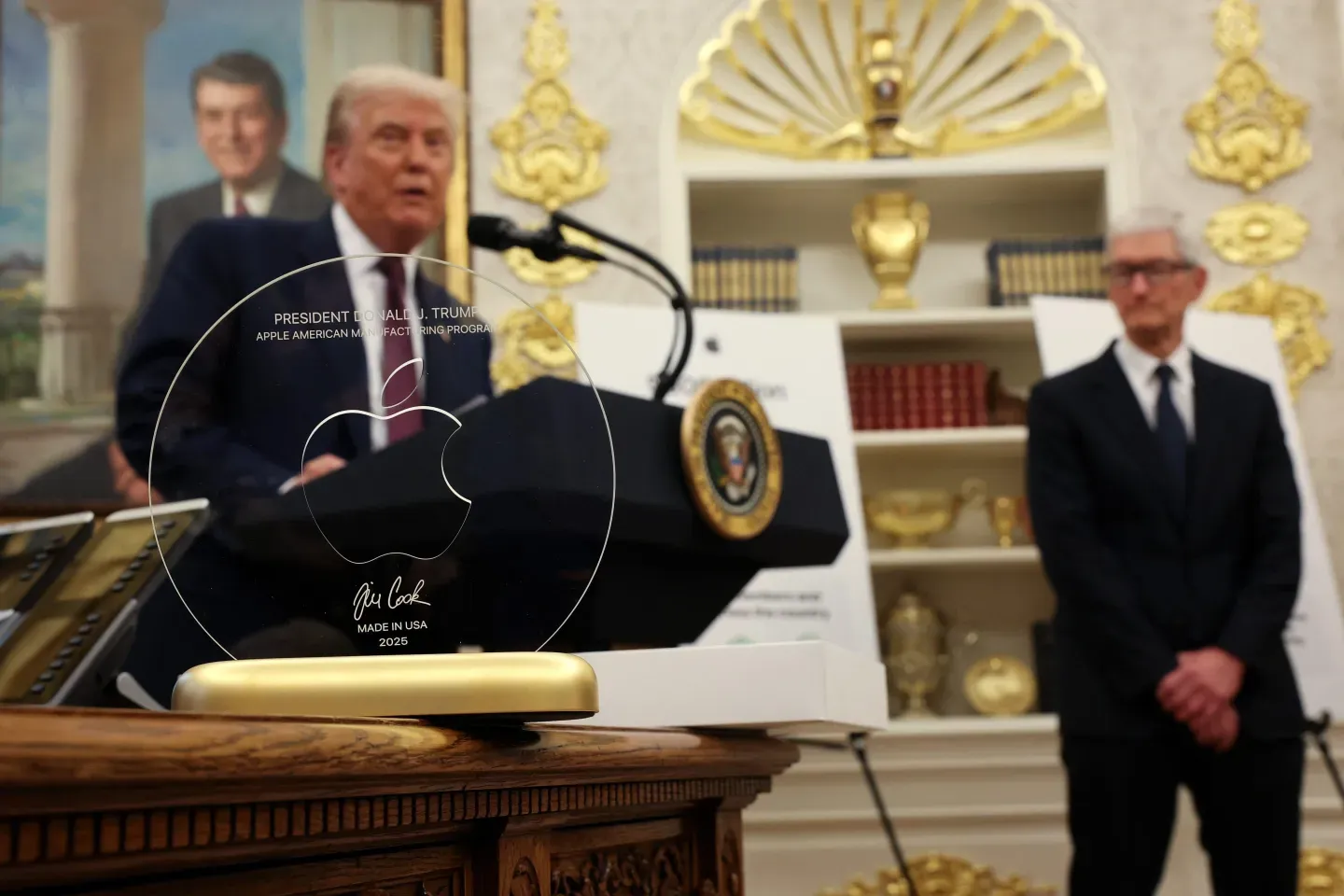
13 October 2017 ↩︎The gift: a glass disc etched with the Apple logo, inscribed “President Donald J. Trump — Apple American Manufacturing Program,” signed by Cook, “Made in USA, 2025,” mounted on a 24-karat gold base. Behind it, Trump stands beneath a portrait of Ronald Reagan, with Apple CEO Tim Cook to his left. The glass was manufactured by Corning in Kentucky; the gold base was sourced from Utah.
Win McNamee / Getty Images
6 August 2025 ↩︎